
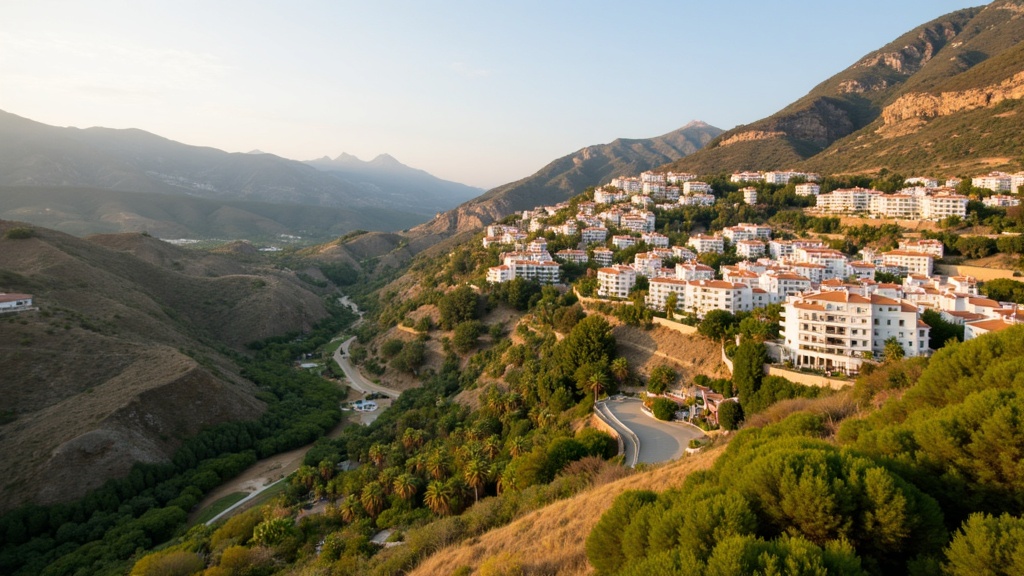
Benahavis: Marbella’s Green Backyard
Benahavis is a mountain village minutes from Marbella that trades the seafront for golf, dining and gated privacy. Foreign buyers should budget roughly 11.2% in tax on a new-build (10% IVA plus 1.2% AJD) or a flat 7% ITP on a resale, plus non-resident income tax via Modelo 210 each year. The golden visa ended on 3 April 2025, so buying no longer grants residency on its own.
Benahavis is Marbella’s green backyard: a whitewashed mountain village barely fifteen minutes inland from Puerto Banus, yet a world away in pace and scenery. Wrapped in the foothills of the Serrania de Ronda and threaded by three rivers, the Guadalmina, the Guadaiza and the Guadalmansa, it delivers the golf, dining and gated privacy of the Costa del Sol without the seafront crowds 5. This lifestyle guide explains what makes Benahavis special and, just as importantly, what a foreign buyer needs to understand about the taxes, ownership costs and paperwork that come with a home here.
Benahavis: a mountain village minutes from the sea
Benahavis sits at around 150 metres above sea level, roughly 7 kilometres from the coast, and spreads across a generous 145 square kilometres of largely unspoilt terrain 5. The permanent population is small, close to 9,500 residents, which is part of the appeal: this is one of the most mountainous and least built-up municipalities on the western Costa del Sol 5. Founded in the late eleventh century and granted its own charter in 1572, the old town is a knot of steep, flower-lined streets that still feels Andalusian rather than resort-built 5.
The setting is the headline. The municipality is drained by three rivers and backs onto the Serrania de Ronda, with the Sierra de las Nieves National Park within easy reach 5. That combination of protected countryside and proximity to Marbella is why Benahavis is so often described as Marbella’s green backyard, and why buyers who want space, views and privacy gravitate here rather than to the busier coastal strip.
The lifestyle: golf, dining and open country
Benahavis has built its reputation on three things: golf, gastronomy and gated living. Several championship golf courses sit within or on the edge of the municipality, and the village itself is widely known along the coast as a dining destination, with an unusually high concentration of restaurants for its size. It is also home to some of Europe’s best-known private estates, including La Zagaleta and El Madronal, whose security, plot sizes and price points draw ultra-prime international buyers.
For everyday life, the draw is the outdoors. River pools such as the Charco de las Mozas, walking and cycling routes into the sierra, and quick access to the beaches of Marbella and Estepona give owners both mountain and coast on the same day. If you are weighing this against neighbouring hotspots, it pairs naturally with our destination guides to Marbella and Estepona, and with our lifestyle notes on golf and the Costa del Sol climate.
What it costs to buy in Benahavis
Property in Benahavis is taxed under the same Andalusian rules as the rest of Malaga province, and the first fork in the road is whether you buy new or resale.
A new-build (a first sale straight from the developer) carries IVA, Spain’s value added tax, at 10% of the price, plus Actos Juridicos Documentados (AJD, stamp duty) at the Andalusian general rate of 1.2%, for a combined tax burden of about 11.2% 13. A resale home is instead subject to Impuesto sobre Transmisiones Patrimoniales (ITP), Andalusia’s transfer tax, at a flat 7% 13. The taxable base for ITP is the higher of the price declared in the deed or the property’s valor de referencia (the official reference value), so an unusually low declared price will not reduce the bill 3. ITP must be settled within 30 calendar days of signing at the notary 3.
From 1 January 2026, Andalusia tightened the reduced 2% ITP rate used by professional operators who buy to resell: it now applies only up to a declared value of 500,000 euros per unit including annexes, and the property must be resold within two years rather than five 4. This is aimed at trade buyers rather than a family purchasing a home, so most foreign owner-occupiers will pay the standard 7% on a resale.
On top of the main tax, budget for notary fees (roughly 750 to 1,400 euros on the official scale), land registry fees (around 400 to 950 euros) and an independent lawyer at approximately 1% plus VAT 13. As a rule of thumb, allow about 10% on top of the price for a resale and 12% to 14% for a new-build once every cost is included 12. For the detail behind these figures, see our dedicated guides to the ITP transfer tax and to IVA and AJD on new-build purchases.
| Cost item | New-build | Resale |
|---|---|---|
| Main purchase tax | 10% IVA + 1.2% AJD (about 11.2%) | 7% ITP (flat) |
| Taxable base | Purchase price | Higher of price or valor de referencia |
| Notary + land registry | Approx. 1,150 to 2,350 euros | Approx. 1,150 to 2,350 euros |
| Legal fees | Approx. 1% + VAT | Approx. 1% + VAT |
| All-in rule of thumb | 12% to 14% of price | About 10% of price |
If you buy off-plan, ask your lawyer to confirm that stage payments are protected by bank guarantee under Ley 57/68, the law that shields deposits paid before completion.
Owning as a non-resident: the annual taxes
Once you own, Spain taxes non-residents through Impuesto sobre la Renta de no Residentes (IRNR), declared on Modelo 210. Residents of the EU, Iceland, Norway and Liechtenstein pay 19% on net income, while residents of other countries pay 24% on gross income with no expense deductions 2. This matters because it changes the effective cost of ownership depending on your home country.
Even if you never let the property, Spain applies an imputed income to a second home in your own use. The tax base is 1.1% or 2% of the cadastral value depending on when that value was last revised, and your IRNR rate then applies to that figure 2. If you do rent the home out, the rental income is taxable at the same rates, and EU/EEA residents may deduct related expenses while others generally cannot 2. On top of IRNR you pay Impuesto sobre Bienes Inmuebles (IBI), the annual municipal property tax, whose rate is set by each town hall and therefore varies locally 2. Our guide to Modelo 210 and non-resident income tax walks through the filing calendar in full.
Selling on: the 3% retention and plusvalia
When a non-resident sells a Spanish property, the buyer must withhold 3% of the price and pay it to the tax office on the seller’s behalf as an advance against the seller’s capital gains tax 2. The seller then files to settle the actual gain and can reclaim any excess. Separately, the seller pays plusvalia municipal, the local tax on the increase in land value, which each council sets within legal maxima, so there is no single national rate 2. Factor both into any resale plan, and read our guide to capital gains and the plusvalia for worked examples.
Visas and residency: life after the golden visa
An important change for non-EU buyers: Spain’s golden visa, which once granted residency in exchange for a 500,000 euro property investment, was abolished on 3 April 2025 6. Buying in Benahavis, at any price, no longer confers a residence permit by itself. EU, EEA and Swiss nationals still enjoy free movement and can register as residents. Non-EU buyers who want to live here typically use the non-lucrative visa, which requires proof of sufficient savings (broadly in the region of 30,000 euros) and private medical insurance but does not permit local employment, or the digital nomad visa for those working remotely for clients outside Spain 6. Our residency guide compares these routes in more depth.
Getting there, schooling and healthcare
Benahavis is served by Malaga-Costa del Sol Airport, roughly an hour’s drive away along the AP-7 and A-7, putting most of northern Europe within a short flight. Families are well covered by the international schools clustered around Marbella and Estepona, and residents can use both the Andalusian public health system, once registered, and the extensive private clinics of the coast. Every foreign buyer will also need an NIE (the foreigner’s identification number) to complete a purchase and to file taxes; see our guides to getting your NIE and to opening a Spanish bank account before you sign.
Benahavis rewards buyers who want the Costa del Sol lifestyle at one remove from the coast: greener, quieter and more private, but still minutes from Marbella’s marinas and Malaga’s airport. Get the tax and paperwork right from the start, and the green backyard is yours to enjoy.
Frequently asked questions
Where is Benahavis and how far is it from Marbella?
Benahavis is a mountain village in Malaga province on the western Costa del Sol, sitting at about 150 metres above sea level and roughly 7 kilometres from the coast 5. It lies between Marbella, Estepona and Ronda, and Puerto Banus is only about fifteen minutes away by car.
How much tax do I pay when buying property in Benahavis?
It depends on new versus resale. A new-build carries 10% IVA plus 1.2% AJD stamp duty, about 11.2% in total, while a resale is taxed at a flat 7% ITP transfer tax 13. Add notary, land registry and legal fees, and budget roughly 12% to 14% on top of the price for a new-build and about 10% for a resale 12.
Does buying a home in Benahavis give me Spanish residency?
No. Spain abolished the golden visa on 3 April 2025, so a property purchase no longer grants a residence permit 6. Non-EU buyers who want to live here generally apply for the non-lucrative visa (savings plus private health insurance) or the digital nomad visa for remote workers 6. EU, EEA and Swiss nationals retain free movement.
What taxes will I pay every year as a non-resident owner?
You file non-resident income tax (IRNR) on Modelo 210: 19% on net income for EU/EEA residents and 24% on gross income for others 2. If the home is for your own use, tax applies to an imputed income of 1.1% or 2% of the cadastral value 2. You also pay the annual municipal property tax, IBI, whose rate is set by the town hall 2.
What happens tax-wise when a non-resident sells in Benahavis?
The buyer withholds 3% of the sale price and pays it to the tax authority as an advance against the seller's capital gains tax; the seller reconciles the actual gain afterwards and reclaims any excess 2. The seller also pays plusvalia municipal, a local tax on the increase in land value, set by the council within legal limits 2.
Do I need an NIE to buy in Benahavis?
Yes. Every foreign buyer needs an NIE, the foreigner's identification number, to complete the purchase, pay the taxes and later file Modelo 210. It is straightforward to obtain through a Spanish consulate or in Spain, and most buyers arrange it alongside opening a local bank account before signing.