
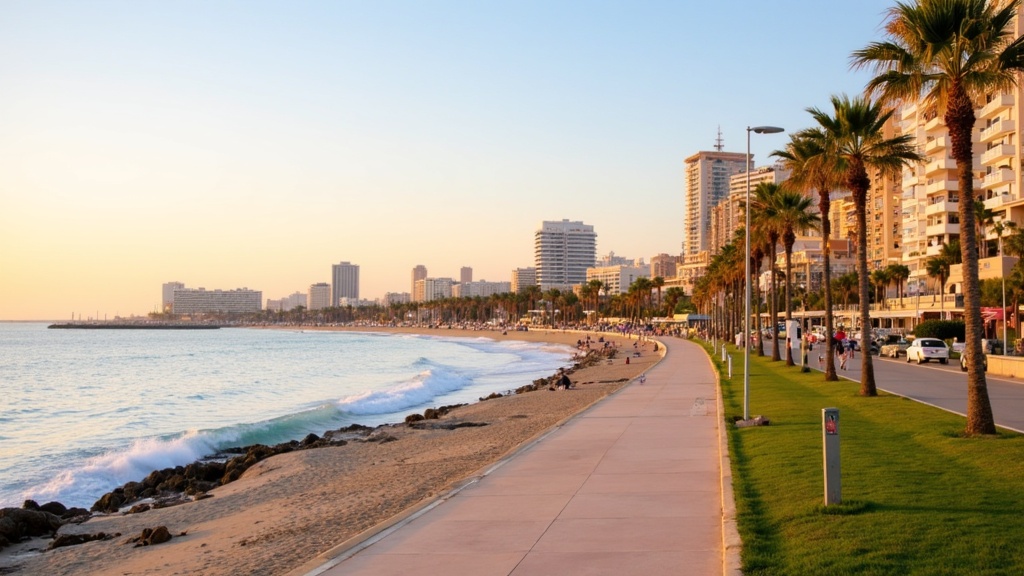
Fuengirola for Families and Rental Yield
Fuengirola pairs a genuinely year-round family lifestyle with strong short and long-let demand, thanks to its beaches, direct Cercanias train to Malaga airport and dense amenities. Buyers should budget roughly 12 to 13 per cent over the price of a new build (10 per cent IVA plus AJD and fees), then plan for annual IRNR via Modelo 210 and IBI as ongoing costs.
Fuengirola is one of the Costa del Sol towns that works for families and for rental yield at the same time, which is rare on a coast where many resorts empty out in winter. This guide explains what a foreign buyer should weigh up before buying new-build property in Fuengirola: the day-to-day family case (transport, schools, healthcare, beaches), the honest purchase maths, and the taxes you keep paying once you own. Every figure below is tied to a source, and Spanish legal and form names are kept as they appear on official documents so you can match them later.
Why Fuengirola suits families
Fuengirola is a compact, permanently lived-in town rather than a seasonal enclave. It had a registered population of 85,211 in January 2025 and offers more than 8 km of beaches along a continuous seafront promenade.5 That density matters for families: schools, clinics, supermarkets and sports facilities are walkable, and the town stays open through the winter rather than shutting down. Attractions such as Bioparc Fuengirola, a conservation-focused zoo, add to the year-round appeal for households with children.5
The same characteristics underpin rental demand. A town that functions all year sustains both holiday lets in summer and longer winter and annual tenancies, which is what gives Fuengirola its reputation for steadier rental yield than more purely seasonal spots nearby.
Getting there and getting around
Fuengirola is the southern terminus of the C-1 Cercanias commuter line run by Cercanias Malaga, with two stations inside the town, Fuengirola and Los Boliches.5 The C-1 runs directly to central Malaga and calls at Malaga-Costa del Sol Airport en route, so arriving relatives and holiday tenants can reach the flat without a car. Malaga-Costa del Sol is the nearest airport.5 For a family weighing school runs, airport trips and car-free living, that direct rail link is one of Fuengirola’s strongest practical advantages on the coast.
Schools and healthcare
The wider Costa del Sol has a long-established network of international and bilingual schools, and public healthcare is provided through the Andalusian regional system (Servicio Andaluz de Salud) with private hospitals also present across the Fuengirola and Mijas area. Because specific school admissions and catchment details change year to year, confirm current places and fees directly with each school before you commit. This pairs naturally with our related guides on relocating with children and on registering for healthcare as a foreign resident.
What a new-build purchase actually costs
Buying a new build from a developer is taxed differently from a resale. On new residential property you pay IVA (VAT) at 10 per cent, plus AJD (stamp duty, Actos Juridicos Documentados).3 In Andalusia the standard AJD rate on a new-build purchase is 1.2 per cent.3 A resale, by contrast, carries no IVA but Impuesto sobre Transmisiones Patrimoniales (ITP) at the Andalusian standard rate of 7 per cent instead.34
On top of tax, budget for legal fees of roughly 1 to 1.5 per cent of the price (or a fixed fee in the low thousands of euros), plus notary and Land Registry charges.4 Adding everything up, buyers should plan for total acquisition costs of around 12 to 13 per cent over the headline price on a new build, versus roughly 8.5 per cent on a resale.4 The table gives the headline components.
| Item | New build (developer) | Resale |
|---|---|---|
| IVA (VAT) | 10% | Not applicable |
| AJD (stamp duty, Andalusia) | 1.2% | Not applicable |
| ITP (transfer tax, Andalusia) | Not applicable | 7% |
| Legal fees | approx 1 to 1.5% | approx 1 to 1.5% |
| Notary and Land Registry | Regulated fixed fees | Regulated fixed fees |
| Indicative total over price | approx 12 to 13% | approx 8.5% |
You will also need an NIE (Numero de Identidad de Extranjero) to complete, and off-plan buyers should confirm that deposit payments are protected under the historic bank-guarantee regime associated with Ley 57/68, so instalments are insured until the property is delivered.
Rental yield and what drives it
The rental case in Fuengirola rests on the year-round demand described above: summer holiday lets, a strong winter market of long-stay northern Europeans, and steady annual tenancies from a permanent resident population.5 The direct airport train supports the short-let end by making the property easy to reach without a hire car.5 Actual gross yield depends heavily on the specific building, floor, sea view and licence status, so treat any single percentage with caution and model your own numbers. Note that tourist (short-term) letting requires registration and licensing under Andalusian rules, and licences are not always available in every building, so verify the letting status of a specific unit before you rely on holiday-let income. Our guide to short-term rental licences on the Costa del Sol covers that process in detail.
Ongoing taxes as a non-resident owner
Once you own, two recurring charges matter. The first is IBI (Impuesto sobre Bienes Inmuebles), the annual municipal property tax, whose rate is set by the town hall and applied to the valor catastral (cadastral value); the registered owner on 1 January is the taxpayer for that year.3
The second is IRNR (Impuesto sobre la Renta de No Residentes), the non-resident income tax, declared on Modelo 210.12 How it applies depends on how you use the property:
- If you let the property, you are taxed on the rental income. The rate is 19 per cent for residents of the EU, EEA, Iceland, Liechtenstein and Norway, who may deduct allowable expenses, and 24 per cent for non-EU residents, with no deductions.2
- If the property is empty or kept for your own use, you still owe tax on imputed income (renta imputada). The taxable base is 1.1 per cent of the cadastral value where that value has been revised within the last ten years, or 2 per cent where it has not, and the same 19 or 24 per cent rate then applies.2
Deadlines matter. Rental-income declarations for a tax year are filed the following year (for 2026 income, between 1 and 20 April 2027), while the imputed-income return is due by 31 December of the following year.2 For a full walkthrough see our dedicated guide to the Modelo 210 for non-resident owners.
Selling later: the 3 per cent retention
When a non-resident sells Spanish property, the buyer is legally required to withhold 3 per cent of the sale price and pay it to the Agencia Tributaria as an advance against the seller’s tax (via Modelo 211).2 The seller then settles capital gains through Modelo 210, and reclaims any excess if the 3 per cent exceeds the tax actually due. The capital gains return is typically filed within about four months of completion.2 Sellers should also budget for plusvalia municipal, the local land-value tax, which the seller normally pays and which each council can calculate by whichever of two permitted methods is more favourable.3 Factoring the retention and plusvalia into your exit maths from the outset avoids surprises at completion.
Financing, visas and related reading
Foreign buyers commonly finance part of a Costa del Sol purchase with a Spanish mortgage, though non-residents are generally offered lower loan-to-value ratios than residents; confirm current terms directly with a lender or broker, as these are commercial rather than statutory figures. On residency, note that Spain’s residence-by-investment (Golden Visa) route was withdrawn in 2025, so buyers seeking to live in Spain should look at other visa categories; check the current rules before assuming any property-linked residency benefit. For the wider picture, pair this guide with our companions on Spanish mortgages for foreign buyers, on visa and residency options after the Golden Visa, and on double-taxation treaties and how your home country credits Spanish tax paid.
In short, Fuengirola offers a genuinely year-round family base with the transport and rental depth to work as an investment too. Get the purchase maths right (around 12 to 13 per cent over the price on a new build), keep Modelo 210 and IBI diarised each year, and plan your exit around the 3 per cent retention, and the numbers stay as friendly as the town.
Frequently asked questions
How much tax do I pay when buying a new-build flat in Fuengirola?
What is the difference in tax between a new build and a resale?
Do I have to file Spanish tax if I never rent out my Fuengirola property?
Yes. Even if the home is empty or only for your own use, non-residents owe IRNR on imputed income (renta imputada), declared on Modelo 210. The base is 1.1 per cent of the cadastral value if it was revised in the last ten years, or 2 per cent otherwise, taxed at 19 per cent (EU/EEA) or 24 per cent (non-EU). The return is due by 31 December of the following year.2
What tax rate applies to my rental income as a non-resident?
Residents of the EU, EEA, Iceland, Liechtenstein and Norway pay 19 per cent and may deduct allowable expenses. Non-EU residents pay 24 per cent on gross income with no deductions. Both are declared on Modelo 210.2
What happens tax-wise when I sell?
The buyer must withhold 3 per cent of the sale price and pay it to the Agencia Tributaria via Modelo 211 as an advance on your capital gains tax. You then settle the gain on Modelo 210, usually within about four months of completion, and reclaim any excess. The seller also normally pays plusvalia municipal to the town hall.23
Can I get a Spanish mortgage as a foreign buyer in Fuengirola?
Yes, but non-residents are generally offered lower loan-to-value ratios than Spanish residents, and terms are set commercially by each lender rather than by law. Confirm current conditions with a bank or mortgage broker before budgeting, and see our guide to Spanish mortgages for foreign buyers.