
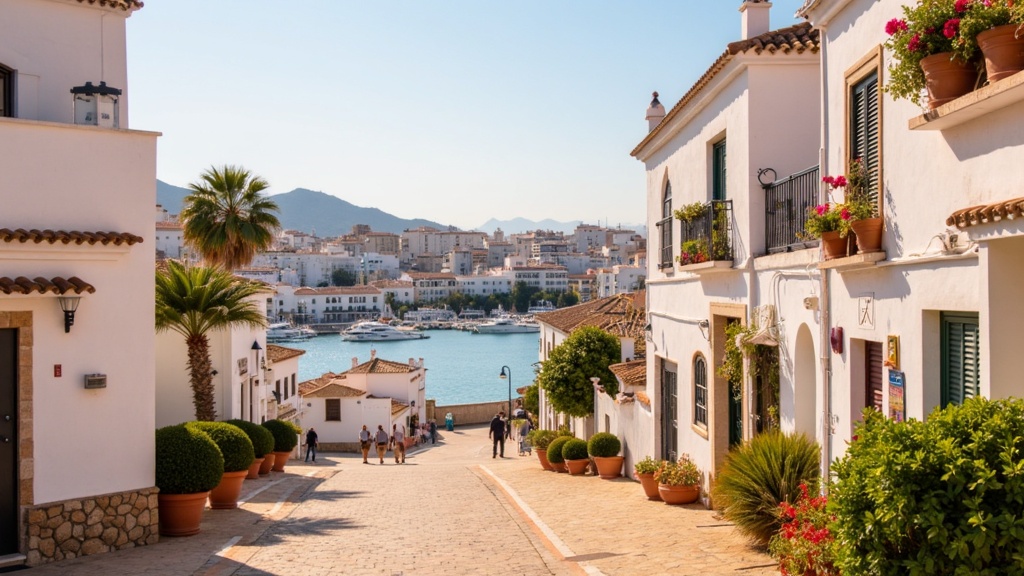
Estepona Old Town vs the New Golden Mile
Estepona Old Town offers walkable Andalusian character and mostly resale flats, while the New Golden Mile is a modern coastal strip of new-build gated resorts and villas. The two feel very different to live in, but the purchase taxes follow the property type, not the postcode: roughly 11.2% on a new build (10% IVA plus 1.2% AJD) versus 7% ITP on a resale.
Choosing between Estepona Old Town and the New Golden Mile is one of the first real decisions a foreign buyer faces on this stretch of the Costa del Sol. Both sit within the same municipality of Estepona, a town of around 79,600 residents that markets itself as the Garden of the Costa del Sol, yet they offer almost opposite ways of living. 1 This guide compares the lifestyle, the typical property on offer and, crucially for a purchase decision, the taxes and running costs that apply to each. The headline point to keep in mind throughout: in Estepona the tax you pay is driven by whether the home is a new build or a resale, not by which neighbourhood it sits in.
Two very different Esteponas
Estepona Old Town is the historic core: a lattice of narrow, pedestrian-friendly streets of restored 18th and 19th century houses, each street painted to its own colour scheme, threaded with more than 40 large-scale murals on building facades. 1 The New Golden Mile, by contrast, is not a town centre at all. It is the modern coastal corridor running east from Estepona towards San Pedro de Alcantara and Marbella, built up over the last two decades with gated residential resorts, golf, beach clubs and hotels. One is a working Andalusian town you walk through; the other is a car-oriented ribbon of contemporary developments along the sea.
Estepona Old Town: the case for the historic centre
The appeal here is authenticity and walkability. You can live without a car for daily life, with the weekly market, tapas bars, the marina and the town’s 17 beaches along more than 20 km of coastline all within reach on foot or a short drive. 1 The trade-offs are the ones common to any historic centre: older buildings, smaller floor plans, limited or no private parking, few communal pools and summer footfall in the busiest streets.
Property in the old town is dominated by resale apartments and townhouses rather than new construction, because there is little vacant land to build on. For a buyer this matters at the notary: a resale purchase is taxed under ITP (Impuesto sobre Transmisiones Patrimoniales), not IVA. Andalucia applies a flat ITP rate of 7% on resale homes. 23
The New Golden Mile: the case for the coastal strip
The New Golden Mile is built around modern comfort: spacious apartments and villas with communal gardens, pools, gyms, gated security and, often, sea or golf views. It suits buyers who want turnkey space, underground parking and low-maintenance living, and who are comfortable driving to reach amenities. This is where most of Estepona’s new-build stock sits, which changes the tax picture. A brand-new home bought from a developer is subject to IVA (VAT) at 10% plus AJD (Actos Juridicos Documentados, or stamp duty) at 1.2% in Andalucia, a combined 11.2% before other costs. 24 You never pay both ITP and IVA on the same purchase.
The money: purchase taxes and costs
Because the old town skews resale and the New Golden Mile skews new build, the two areas usually carry different acquisition costs, even for the same price tag. The difference is the tax regime, not a premium on the location itself. The table below sets out the main figures a foreign buyer should budget for.
| Cost | Resale (typical Old Town) | New build (typical New Golden Mile) |
|---|---|---|
| Main purchase tax | ITP 7% 23 | IVA 10% + AJD 1.2% = 11.2% 24 |
| Notary and Land Registry | Fixed statutory scales 2 | Fixed statutory scales 2 |
| Legal/conveyancing fees | Around 1% plus VAT 24 | Around 1% plus VAT 24 |
| Realistic total on top of price | Roughly 9 to 11% 2 | Roughly 13 to 15% 2 |
ITP in Andalucia is charged on the higher of the price paid or the tax authority’s official reference value, and it is due within 30 working days of signing the deed. 2 Reduced ITP and AJD rates exist for cases such as a main residence up to 150,000 euros, buyers under 35 and large families, but most foreign purchasers of a second home pay the standard rates above. 2 Notary and Land Registry fees follow fixed national scales rather than a percentage of price, and an independent lawyer typically charges in the region of 1% plus VAT. 24 A separate guide on new build versus resale costs in Andalucia is worth reading alongside this one.
Financing as a non-resident
If you need a mortgage, the neighbourhood matters less than your tax residency. Spanish banks typically lend non-residents up to 60 to 70% of the valuation, with the buyer covering a valuation fee of roughly 300 to 600 euros, so you should budget the balance plus all purchase taxes in cash. 4 A dedicated guide on getting a mortgage as a non-resident covers the paperwork and the NIE (foreigner identification number) you will need before completion.
Ongoing taxes for non-resident owners
The running costs are the same wherever in Estepona you buy, and they apply to the property regardless of whether it was a new build or a resale. Three items matter most.
- IBI, the annual municipal property tax, set by the town hall and generally in the range of 0.4% to 1.1% of the cadastral value each year. 24
- IRNR, non-resident income tax, filed on Modelo 210. If you do not let the property, Spain still charges an imputed income calculated as 1.1% or 2% of the cadastral value, taxed at 19% for residents of the EU, Iceland, Norway and Liechtenstein, or 24% for other non-residents. If you do let it, rental income is taxed at those same rates, with EU/EEA residents able to deduct expenses and others taxed on the gross. 24
- The 3% retention on sale. When a non-resident sells, the buyer must withhold 3% of the price and pay it to the tax authority as an advance against the seller’s capital gains tax. 2 A separate guide on the 3% retention and Modelo 210 explains how to reclaim any overpayment.
These are money and legal matters, so confirm the current figures and your own position with a registered Spanish tax adviser and the Agencia Tributaria before you commit.
Getting there and living there
Both areas share Estepona’s connectivity. Malaga Airport is roughly 80 km away and Gibraltar Airport around 45 km, the two main gateways for international arrivals. 1 The New Golden Mile has a slight edge for airport runs by car because it sits at the eastern, Marbella-facing end of the municipality, closer to the motorway corridor, while the old town rewards those who value being able to walk to everything day to day.
For families and retirees, the wider Estepona to Marbella area is well served by international schools and by both public and private healthcare, with the public Andalusian health service alongside private clinics common along the coast. Specific schools and hospitals sit outside the scope of this comparison, so check current catchment, admissions and cover for your exact address as part of your due diligence.
Which should you choose?
Pick Estepona Old Town if you want character, walkability and a real Andalusian town, you are comfortable with resale property and its 7% ITP, and you do not mind older buildings and limited parking. Pick the New Golden Mile if you want modern space, resort facilities and turnkey new build, and you accept the higher 11.2% tax on a new home in exchange for a warranty and contemporary specification. In practice many buyers view both, because the same budget buys a very different life a few kilometres apart. Whichever way you lean, run the full purchase costs and the ongoing IRNR and IBI numbers before you decide, and read the companion guides on non-resident taxes and the buying process so there are no surprises at the notary.
Frequently asked questions
Is Estepona Old Town or the New Golden Mile cheaper to buy in?
It depends on the property, not just the area. The old town is mostly resale, taxed at 7% ITP in Andalucia, while the New Golden Mile is mostly new build, taxed at 10% IVA plus 1.2% AJD (11.2%). For the same price, a new build typically carries higher acquisition costs, around 13 to 15% on top versus roughly 9 to 11% for a resale. 234
Do I pay VAT (IVA) or transfer tax (ITP) in Estepona?
You pay one or the other, never both. A brand-new home bought from a developer is subject to IVA at 10% plus AJD stamp duty at 1.2%. A resale home is subject to ITP at the Andalucia flat rate of 7%. Old Town purchases are usually resale (ITP); New Golden Mile purchases are usually new build (IVA plus AJD). 234
What ongoing taxes will I pay as a non-resident owner in Estepona?
Annual IBI municipal tax, typically 0.4% to 1.1% of the cadastral value, and non-resident income tax (IRNR) filed on Modelo 210. If the home is not let, you still pay tax on an imputed income of 1.1% or 2% of the cadastral value, at 19% for EU/EEA residents or 24% for others. Rental income is taxed at the same rates. 24
What is the 3% retention when I sell?
When a non-resident sells a Spanish property, the buyer withholds 3% of the price and pays it to the tax authority as an advance against the seller's capital gains tax. If your actual gain is smaller, you can reclaim the difference through Modelo 210. This applies whether the home is in the Old Town or on the New Golden Mile. 2
Can a non-resident get a mortgage for either area?
Yes. Spanish banks generally lend non-residents up to 60 to 70% of the valuation, so you need the balance plus all purchase taxes in cash, along with a valuation fee of around 300 to 600 euros and an NIE. The area you choose does not change the lending limits; your tax residency and finances do. 4
How far is Estepona from the airport?
Malaga Airport is approximately 80 km away and Gibraltar Airport around 45 km. The New Golden Mile sits at the Marbella-facing end of the municipality, marginally closer to the motorway corridor, while the Old Town is prized for walkability rather than driving convenience. 1